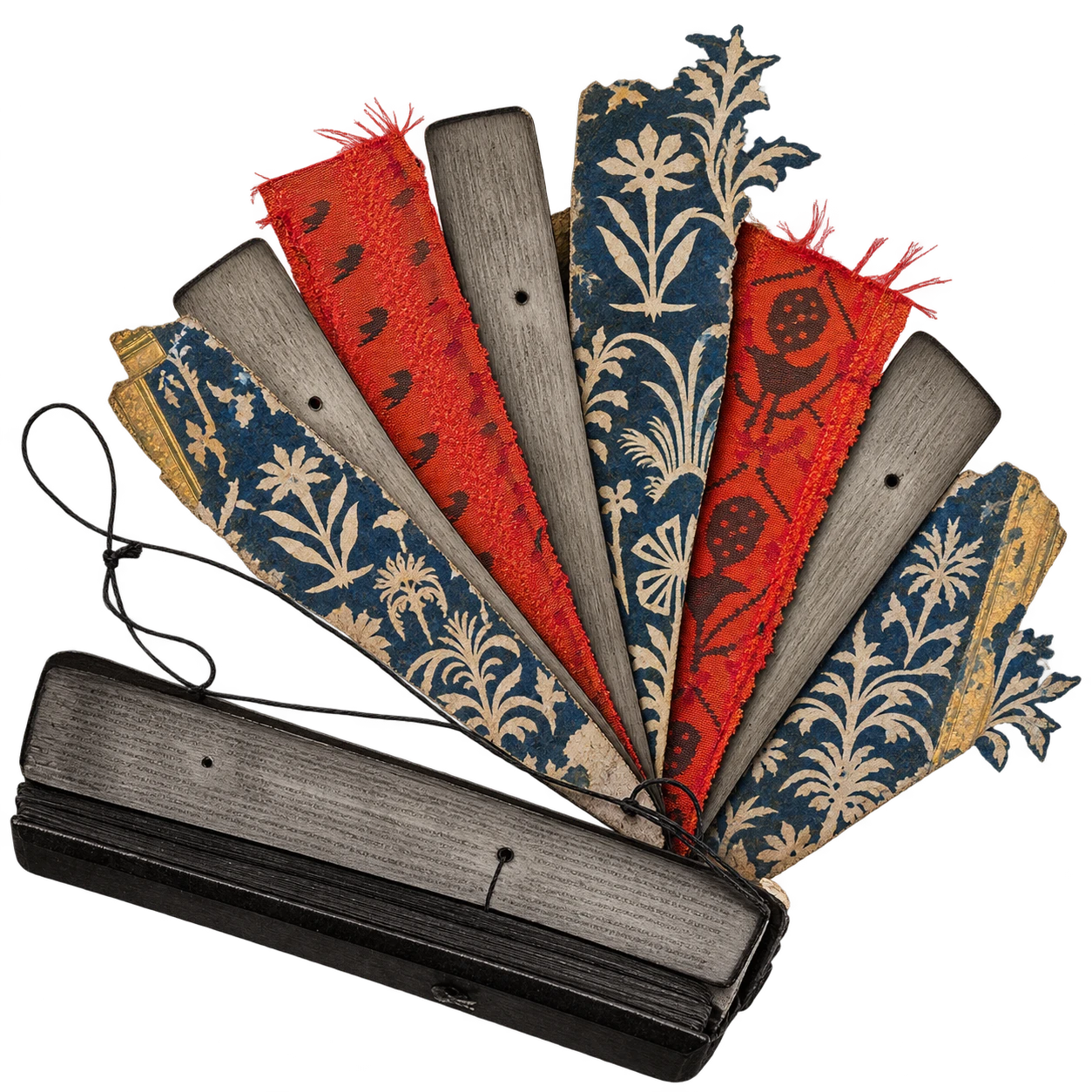
Every picture starts in a museum.
Kantha, bidri, Kalighat, palm-leaf books, Company School birds: we cut them, recombine them and say so. Nothing pretends to be old.
Type & Brand Book · First edition
For Authentic Kahaniyan and Dushyant Arora: their marks, paper, type, pictures, motion, birds and words, and why each one is the way it is.
दुष्यंत अरोड़ाدشینت اروڑاऑथेंटिक कहानियाँآتھینٹک کہانیاں
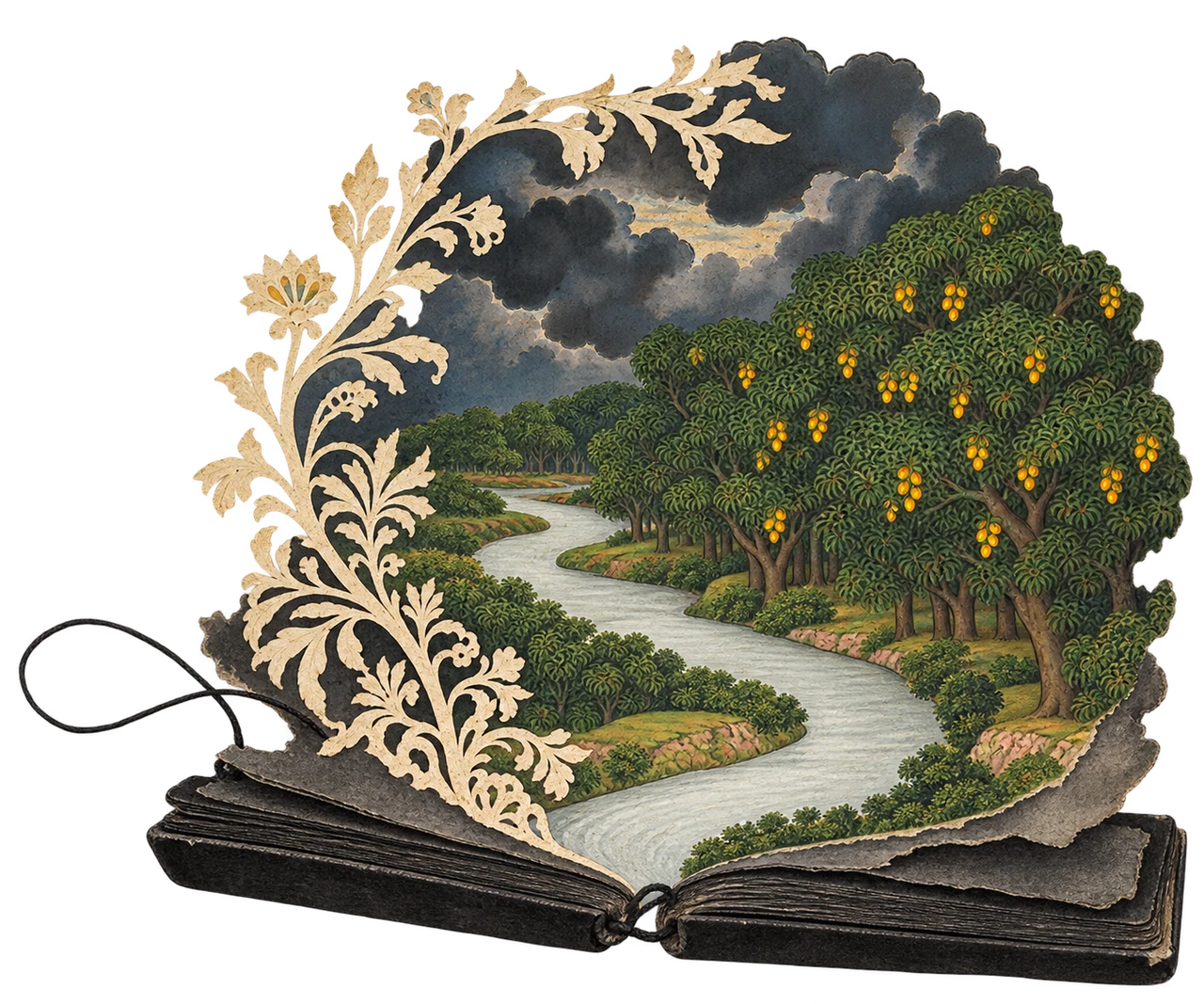
This book
In 1778 a painter from Patna finished a small orange-headed thrush on a branch of kachnar, and signed it twice: his name, Zain al-Din, in Persian, and underneath, in English, “Native of Patna”.1 The painting went into an album.
A muraqqa is a book like that: pictures by many hands, collected, ruled in and floated in flecked margins, with the patrons and the painters named.2 Authentic Kahaniyan collects the stories behind films. Dushyant collects them in what he writes. This book treats them as two albums from the same library and explains every choice we made for them. The stories behind the choices are in the margins.
Read it once in order. After that, keep it as a reference: every number here is the number the websites, decks and posts use.
The idea
Before drawing anything, we asked what an album actually does.
It collects things other people made. It tells you what each one is. And it holds them in a frame that turns a pile of pictures into a page. Research and writing do the same with facts, so the album’s habits became the brand’s rules.
Kantha, bidri, Kalighat, palm-leaf books, Company School birds: we cut them, recombine them and say so. Nothing pretends to be old.
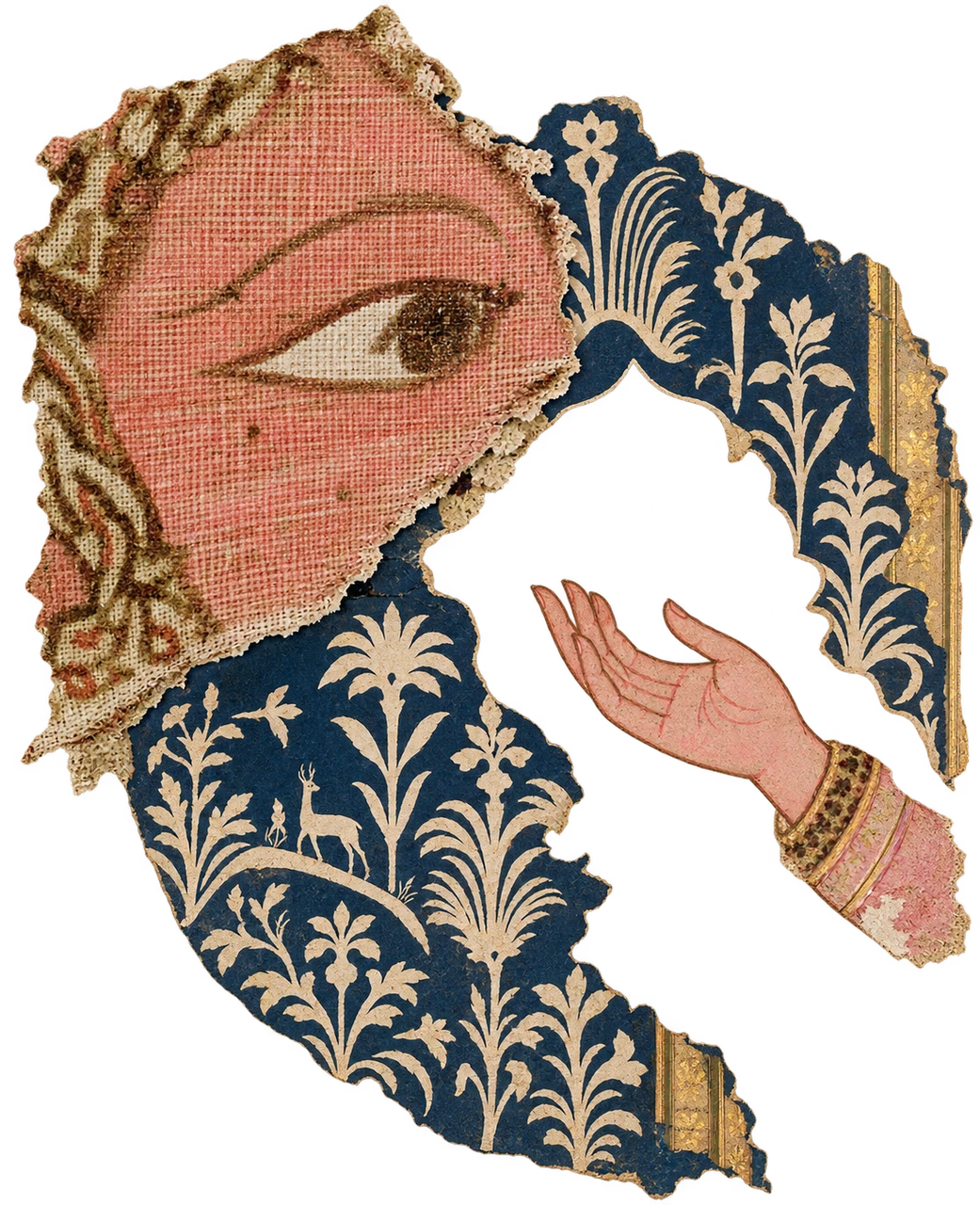
As on a museum wall: a title, what it was made after, an accession number and a way back to the sources.
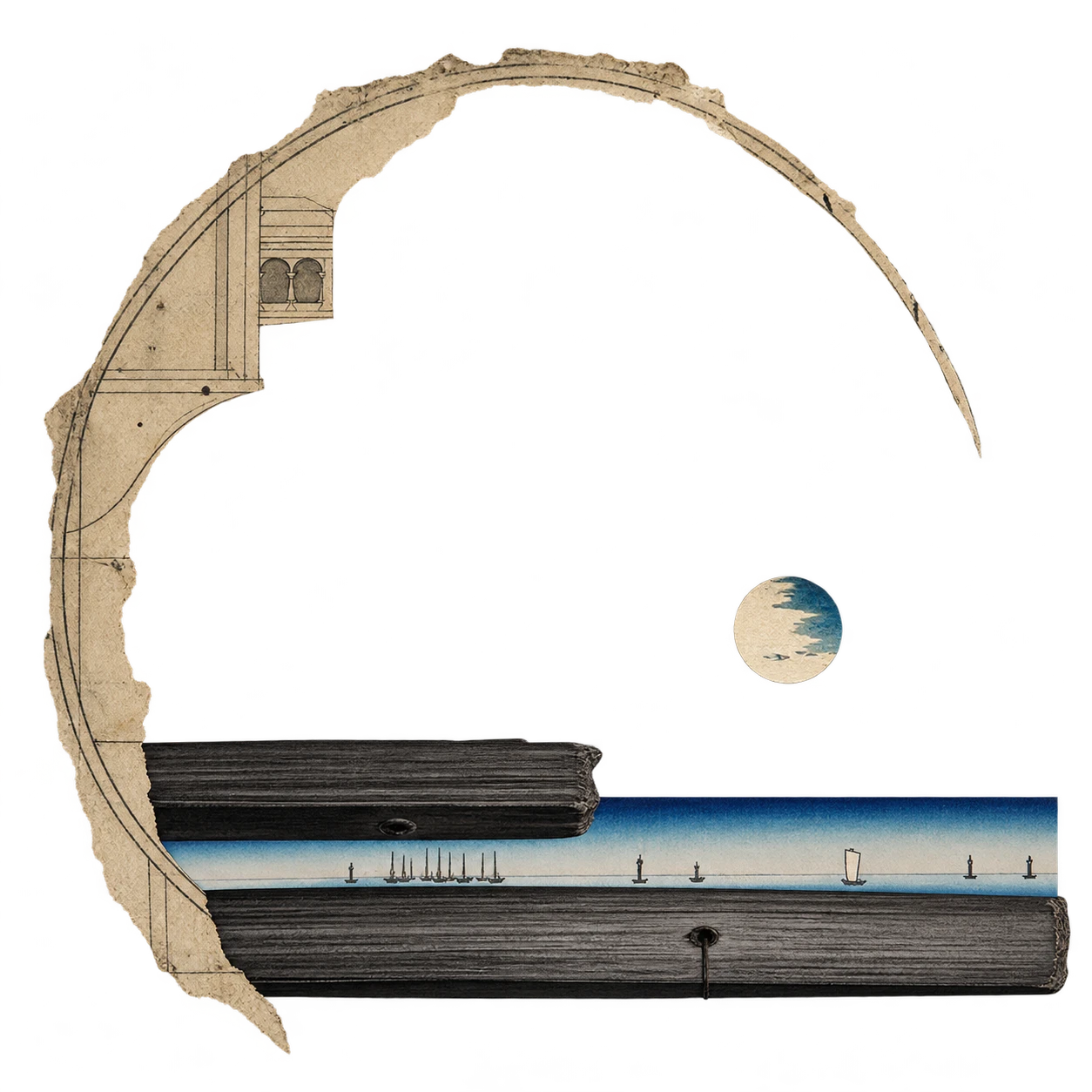
Album pages sit inside ruled lines and a flecked margin. So does every screen, slide and post: a quiet frame at the edge, never ornament in the middle.
Two albums
A visitor should feel the family in a second: the same paper, the same reading type, the same labels.
But one is a practice that takes on commissions, and the other is a lawyer who writes. So each keeps its own mark, display face and voice, and points to the other in its footer as “the other album”.
Authentic Kahaniyan
Research for film and television. Richer and bolder: lac red, indigo and gold on wasli. The patrons are named high up, and the research opens like drawers in a cabinet of finds.
“We”: the practice and its collaborators.
A stamp that says authentic in three scripts.
Zodiak.
Bidri: blackened metal, silver inlay.
The album opens; the drawers; look closer.
Dushyant Arora
A lawyer, writer and researcher, and co-editor of two anthologies. Quieter and led by the writing: ink indigo and leaf green on a paler wasli. The birds of the hour are noted in the margin.
“I”: plainly, and never about how good he is.
His name in three scripts, and a bookplate.
Newsreader, led by its italic.
A garden after dark.
Enter with birdsong or quietly; sighting slips; notes in the margin.
The marks
Archives prove things with stamps.
A document that has been examined is pressed with a seal in ink or lac, and the seal is how the next reader knows it can be trusted.3 Authentic Kahaniyan does that work for a story: it checks the story, finds its sources and hands it on. So its mark is a stamp that says what the name says, three times and never translated: آتھینٹک, AUTHENTIC, ऑथेंटिक. The English word is spelled out in Nastaliq and in Devanagari, the way a Mumbai shop sign would write it.4 Set beside the name, the stamp certifies it.
Our first stamp said AK, and we let it go. Nobody outside our studio calls the practice that, and two capital letters on their own can read as something else entirely.
The first stamp, retired. Its ring of beads lives on in the new one, the only ornament in the system.
The width of the bead ring, about an eighth of the stamp, on every side.
48 px on screen, 14 mm in print. Below that, the small stamp. Wherever it can’t turn it holds the qalam A: favicons, print, and for anyone who asks for less motion.
Lac on wasli first. Night lac on bidri. Wasli on lac to stamp. Black or white only where a partner insists.
Stretch it, outline it, shadow it, rotate it for effect, or let the stamp stand in for the name.
Kahaniyan is the same word in Hindi and in Urdu. Spoken, the two are one language; written, they part, into Devanagari and Nastaliq. The full stamp says AUTHENTIC in both scripts. The small stamp has room for one letter, so it gives that letter both hands.
One A is cut with a qalam, the reed pen trimmed at a slant that gives Urdu its thick and thin. The other hangs from a shirorekha, the headline that runs along the top of written Hindi. On screen, the stamp turns from one to the other, the way Dushyant’s name turns through its scripts.
Dushyant’s name is set the way old Hindi films set their titles.
In English, in Devanagari and in Nastaliq, because the audience read all three.5 Newsreader Display Light on top, Tiro Devanagari and Gulzar beneath, with a small lozenge between them. In his site’s header the name turns through the three, holding English longest.
His mark is a bookplate: the label a reader pastes inside the books he owns, From the books of. It closes his site, signs the back of his deck and heads anything he recommends.
English on top. Devanagari left and Nastaliq right of the lozenge, each read in its own direction.
English at 18 px. Below 28 px the scripts drop to their own line or go.
Ink indigo on paper. Moonlit paper on the night garden. Never lac: lac is the archive’s.
The stamp and the title card never share a lockup. They meet only in footers.
Paper and colour
Indian miniatures were painted on wasli: thin sheets of paper pasted together and burnished smooth with a stone, so a brush with a single hair could work on it.6
That warm, smooth paper is our day. Our night is bidri, the metalwork of Bidar in the Deccan: a dark alloy blackened with a paste made from the soil of the old fort, inlaid with silver that stays bright.7 Dark mode is a different material, never the day turned inside out. Every other colour is lifted from the collages: lac, the indigo of kantha quilts, the gold of a margin.
Authentic Kahaniyan
Day first, then night.
#EFE6D3The ground of every page.
#F7F1E4Cards, labels, raised surfaces.
#1E1A16Text and the name.
#A8361EThe stamp, links, footnotes: the one red thing in a view.
#2B3E5CSecondary actions, the drawers, rules.
#B9893AFlecks and rules only. Never text on wasli.
#141312The night ground.
#E4DFD4Text at night.
#E0685EThe stamp and links on bidri.
#8FA6C9Secondary actions on bidri.
#D4AE64Rules and flecks; text is allowed at night.
#5B5145Paragraphs and captions on wasli.
A note on red
Our red is lac, the resin of a tiny insect that India has harvested for centuries, for sealing wax, for bangles and for the red dye of old textiles.8 It sits ten degrees round the colour wheel. Saffron sits at thirty. The gap is on purpose.
Colours shouldn’t belong to anyone, but a few have been borrowed for so long that standing next to them says something you didn’t mean. Lac was sealing letters here long before anyone had a party flag.
8Lac comes from the Sanskrit lākṣā. Tradition ties it to lakh, a hundred thousand: roughly how many insects a little of it takes.
Dushyant Arora
A paler wasli, closer to a notebook page, and the colours of ink and leaves. At night the page becomes a garden after dark.
#F3EDE1The ground.
#FAF6EECards and sighting slips.
#1C1B19Text.
#2C3F73His name, links, the active thing.
#4D6A3CBirds, the field log, the hour.
#10140FThe night ground.
In any view of Authentic Kahaniyan:
Wasli 70 · Ink 18 · Lac 6 · Indigo 4 · Gold 2
In any view of Dushyant Arora:
Paper 74 · Ink 20 · Indigo 4 · Leaf 1.5 · Gold 0.5
One switch, the same on every site we make for this family. Both words are always visible, so it never changes size. The ink thumb slides between them on the Turn curve. It follows the visitor’s device until they touch it, then remembers their choice.
132 × 34 px · Switzer 560, 10.5 px, +14% · thumb 600 ms on Turn
Type
Type has two jobs here: to read easily at length, and to sound like its album.
Both sites are mostly words, so everything long is set in Newsreader, a serif drawn for reading the news on screens.9 Zodiak gives Authentic Kahaniyan the confidence of a museum catalogue, a little grand. Dushyant’s headlines stay in Newsreader, large and in its italic, because his is a reader’s voice. Switzer writes the labels, as a museum would. Hindi and Urdu are set in fonts made by people who give those scripts the same care: Tiro Devanagari and Gulzar.10
Aa
AK display
300 italic to 700. Jérémie Hornus, Indian Type Foundry.
Aa
Reading · Dushyant display
A Text cut for paragraphs, a Display cut for headlines. Production Type.
Aa
Labels · navigation
Small, in capitals, tracked wide. Indian Type Foundry.
कहा
Hindi
Drawn to sit beside a serif. John Hudson and Fiona Ross, Tiro Typeworks.
کہا
Urdu
Nastaliq, set properly. Borna Izadpanah and Fiona Ross.
Sizes at 1440 px wide and on a 390 px phone. Tracking in Adobe units (1/1000 em) and Figma percent.
A story has a world to live in.
Zoya Akhtar · Hansal Mehta
Research, from development to production.
An idea may begin with a place you have never been.
We research military, business and political histories through archives, contemporary accounts and later scholarship.
Plate 07 · AK.26.07 · Sources
The same units. His pages are set a little larger and looser: they are for reading.
A lawyer who writes on courts, politics and cinema.
The hearing before Yakub Memon’s execution
At 3.30 am, the Supreme Court began hearing a plea ahead of Yakub Memon’s scheduled execution at 7 am. I was there.
2015
07:42 · Oriental Magpie-Robin · heard
They appear as names and real words only: the names, a bird, a book. Never as texture, never machine-translated, never invented. A reader of each script checks every line before it goes live.
Devanagari · Tiro
ऑथेंटिक
Size it so the headline, the line the letters hang from, sits a fifth above the Latin x-height.
Nastaliq · Gulzar
آتھینٹک
Nastaliq slopes and stacks: give it 1.6 times the leading of Latin and never letterspace it.
A bird’s name
दहियल
The Oriental Magpie-Robin. Bird names go on the sighting slip under the English name, once a reader has checked each one.
Pictures and margins
Fifty-six of them: one for every section of both sites and every page of both decks.
Each starts from open-licence museum art: Kalighat paintings made for pilgrims in nineteenth-century Calcutta,11 Pahari paintings, kantha quilts, bidri boxes, palm-leaf books, Hiroshige’s seas. We cut them, recombine them and label them, so a visitor can always trace a picture back to the hands that made its pieces.
This is Bring the Unfinished Part: three works from three centuries, held in two museums. Look at the moth: it flew in from the thrush painting this book began with.
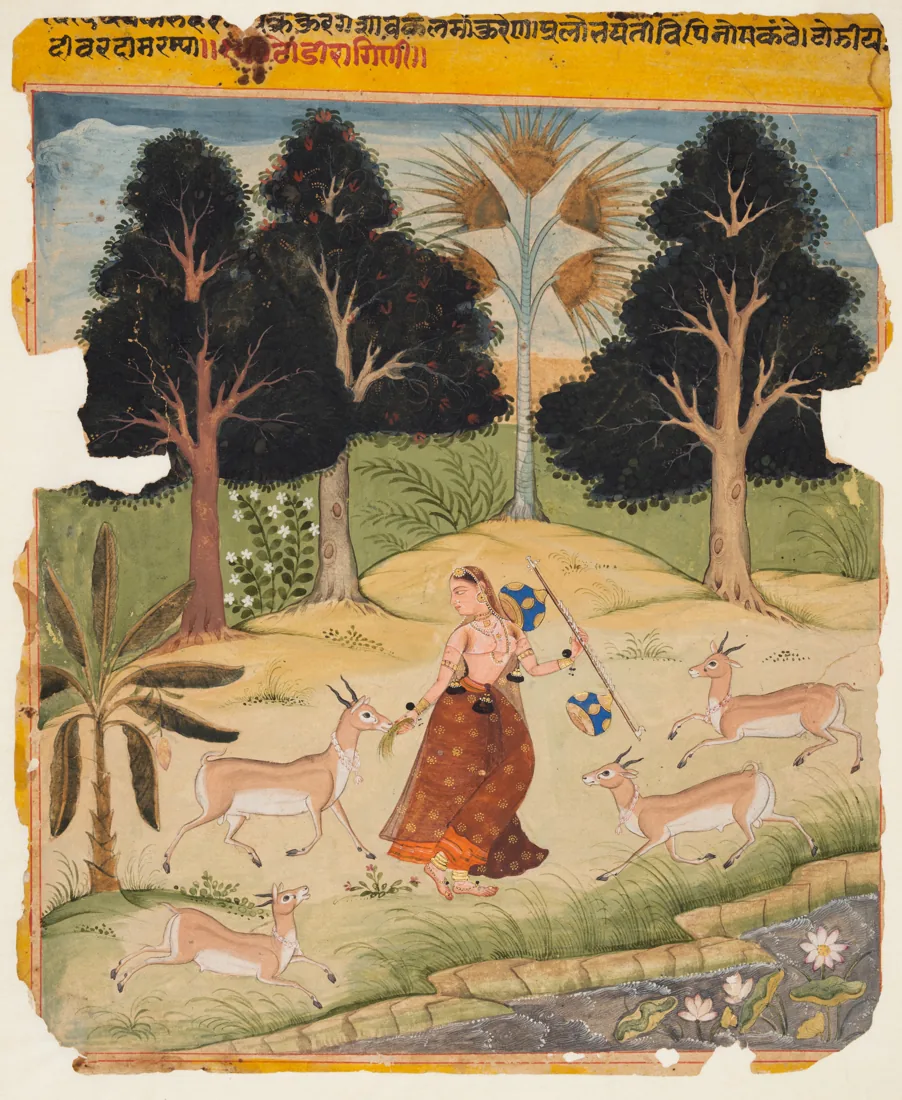
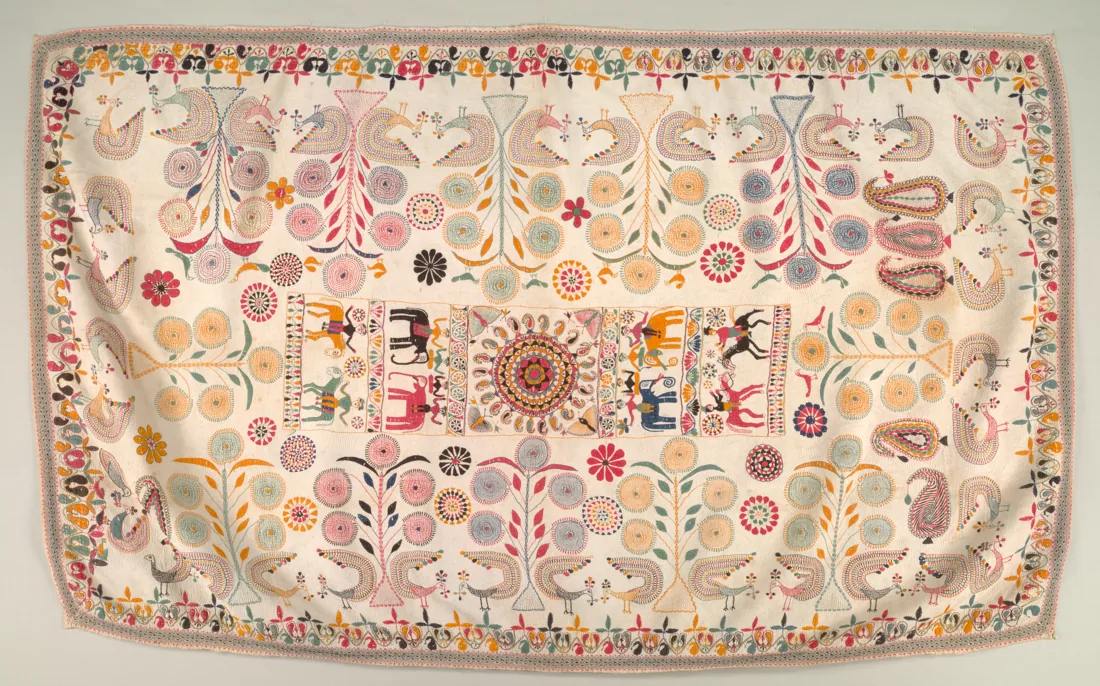
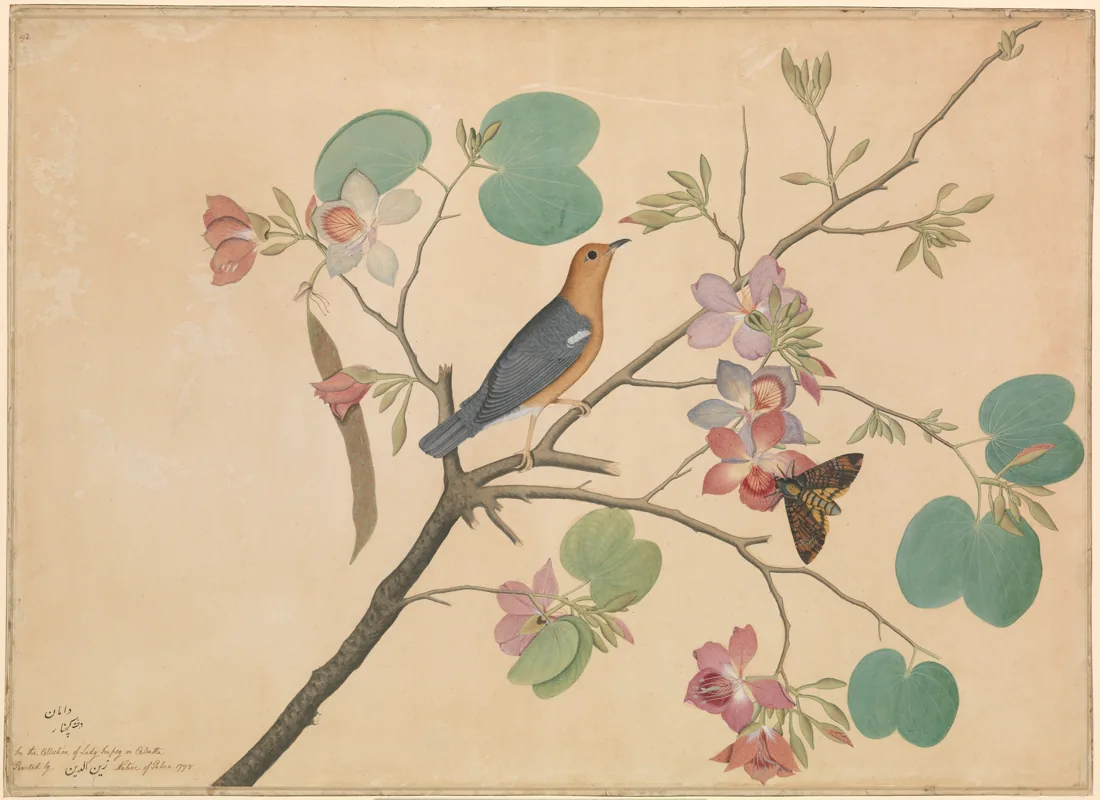
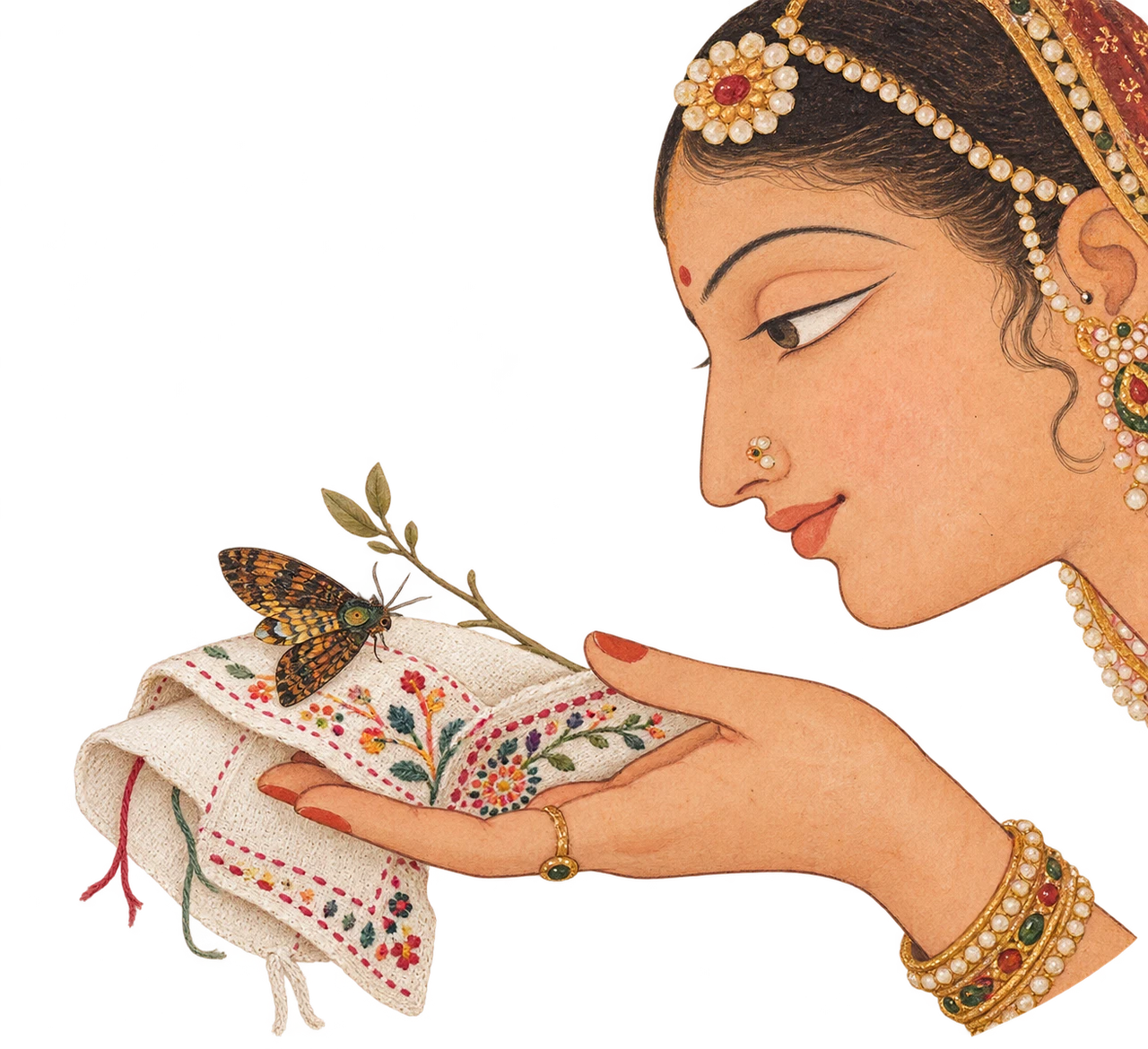
Bring the Unfinished PartCollage after a Todi Ragini (c. 1610), a Bengal kantha and Zain al-Din (1778).AK.26.15
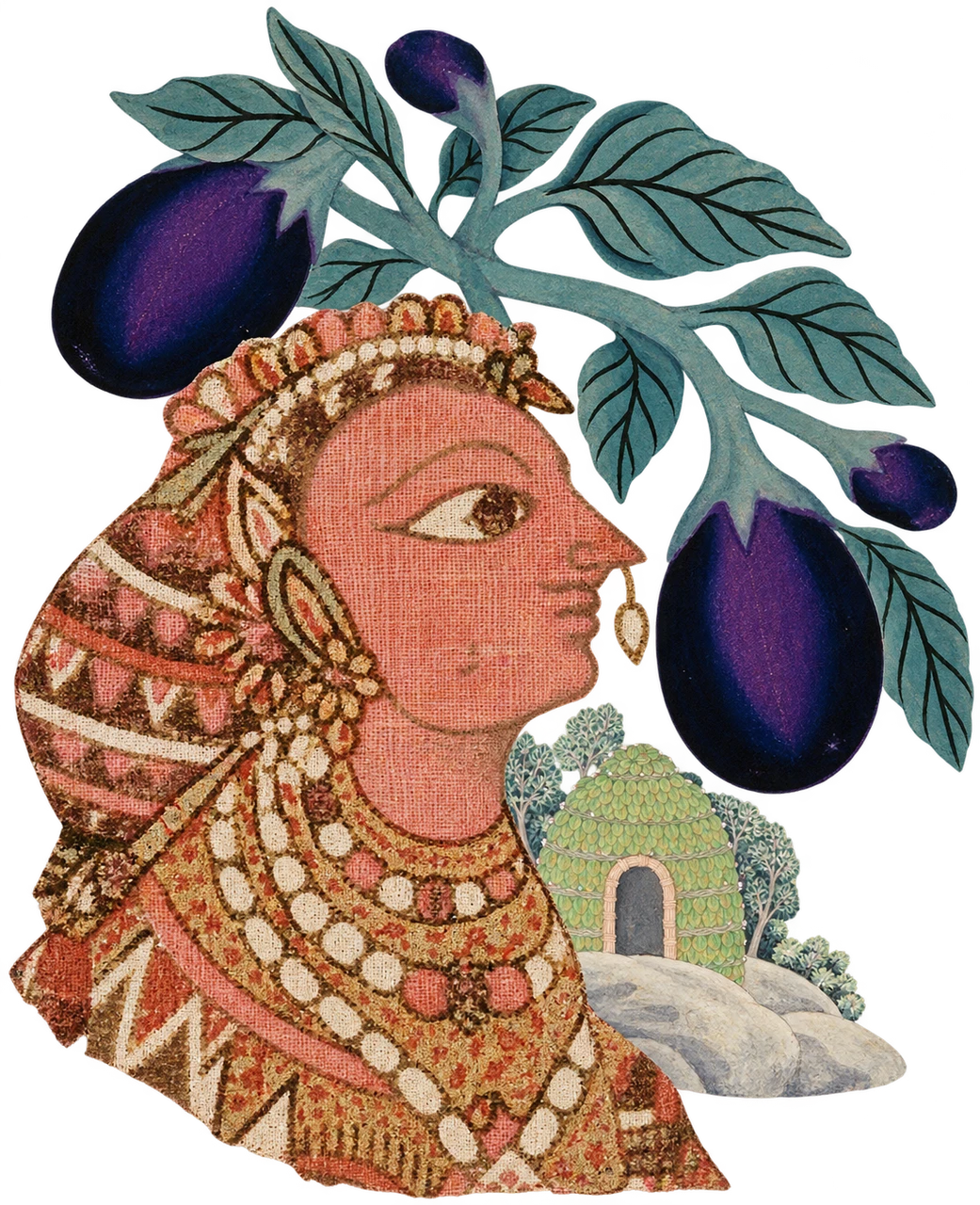
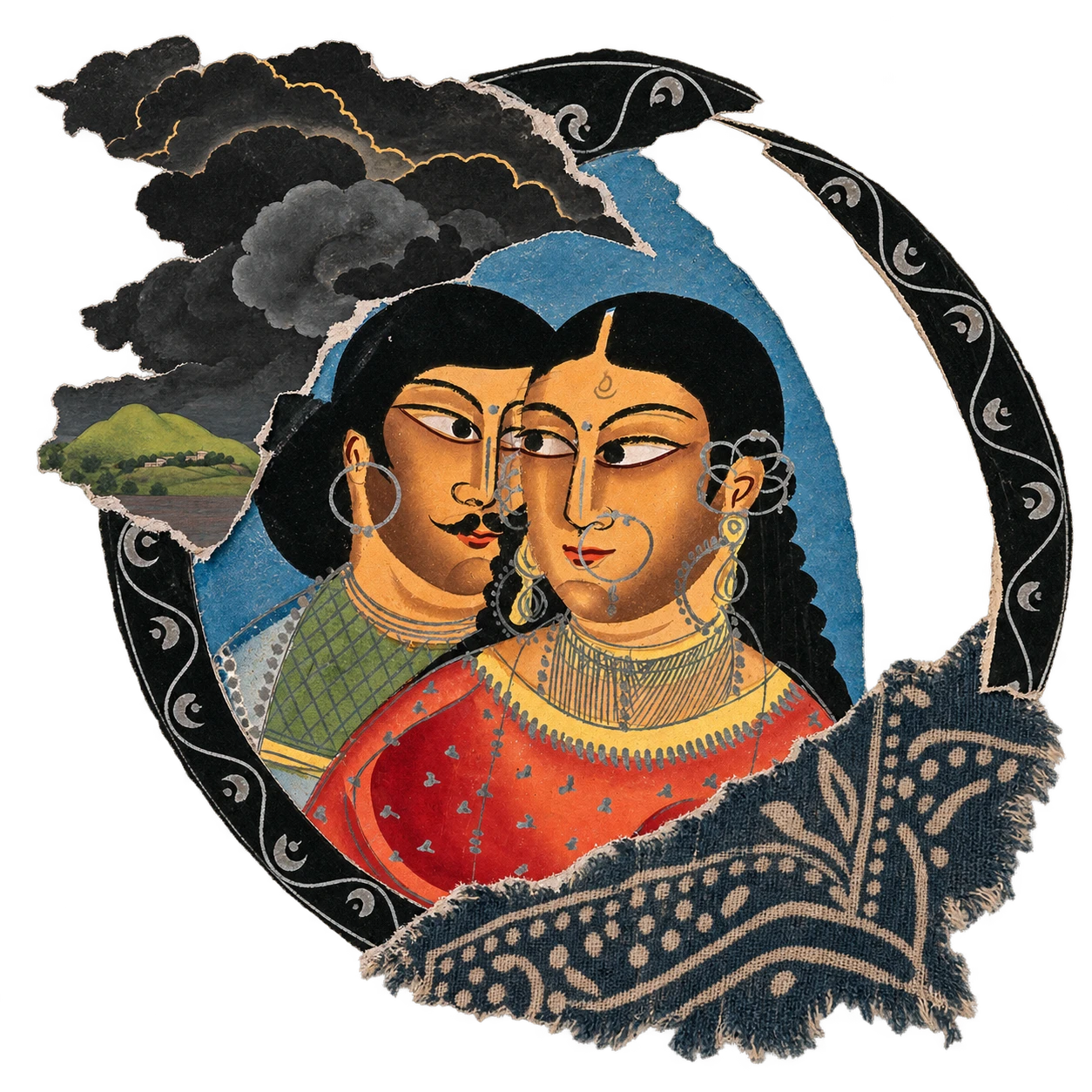
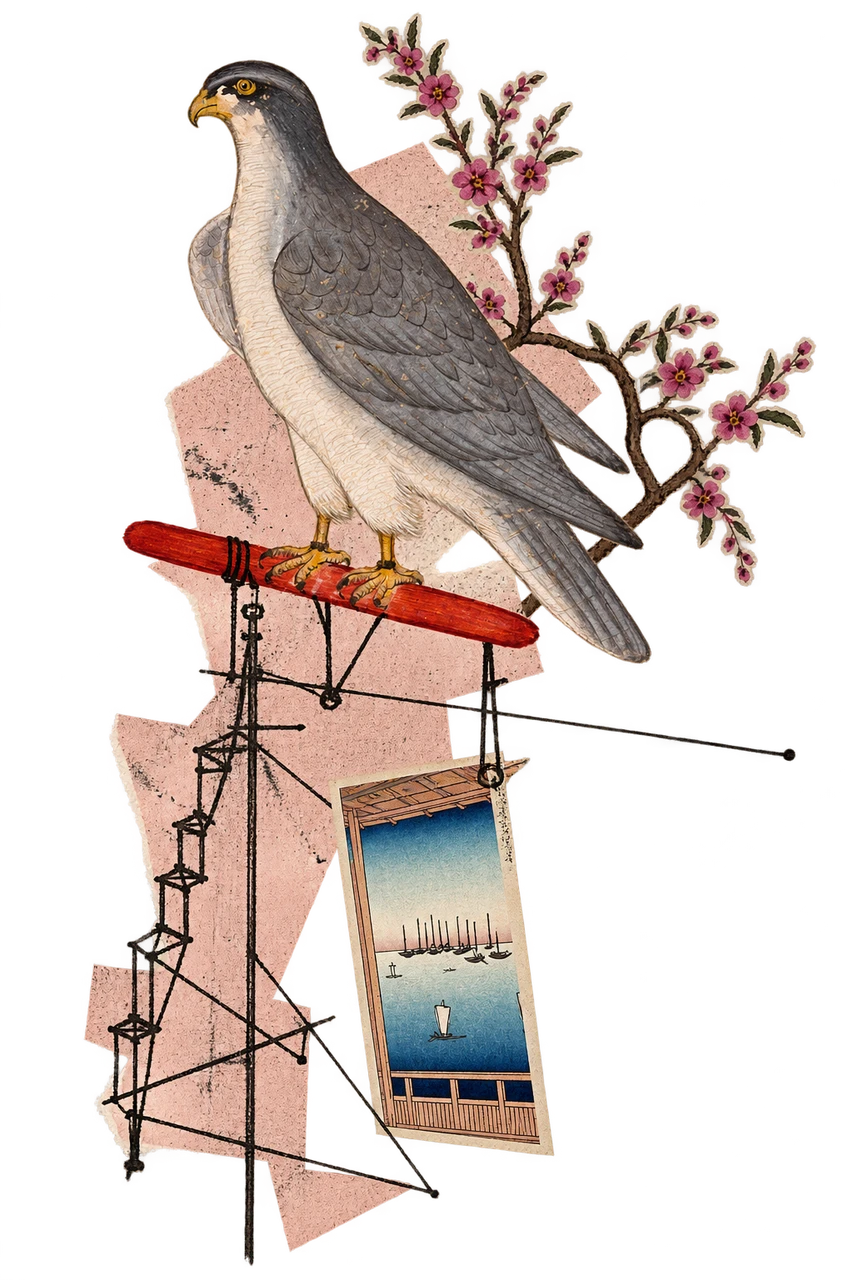
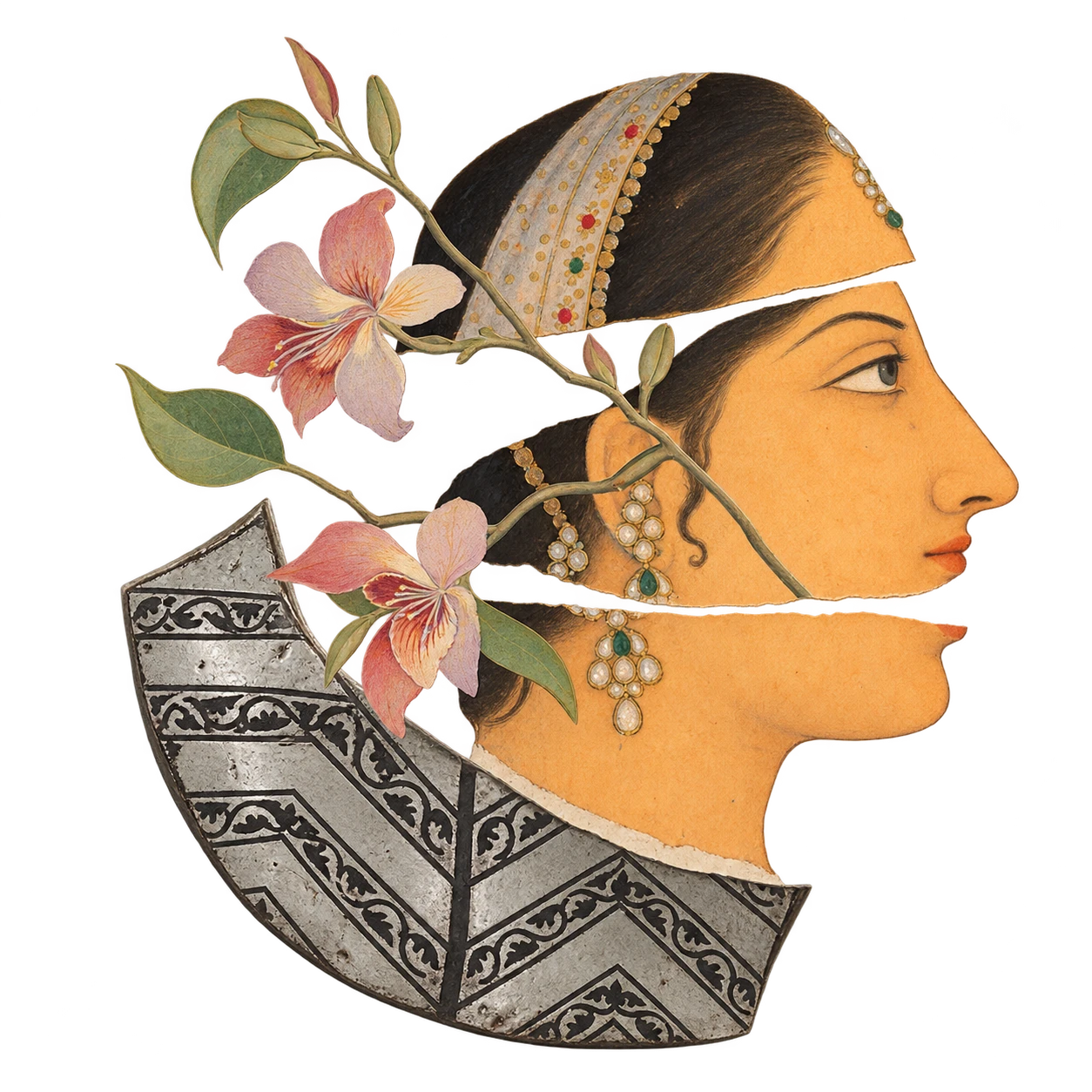
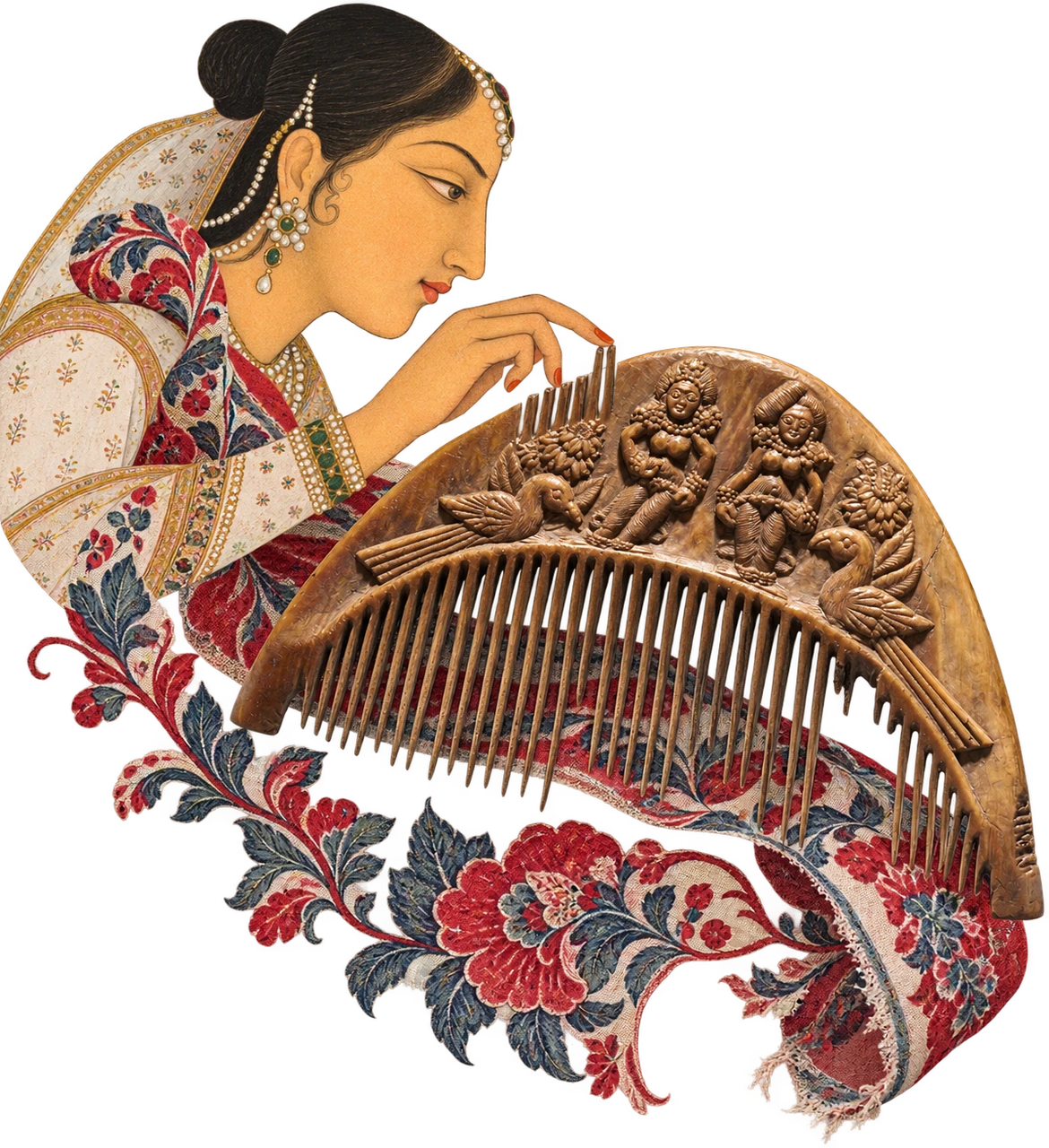
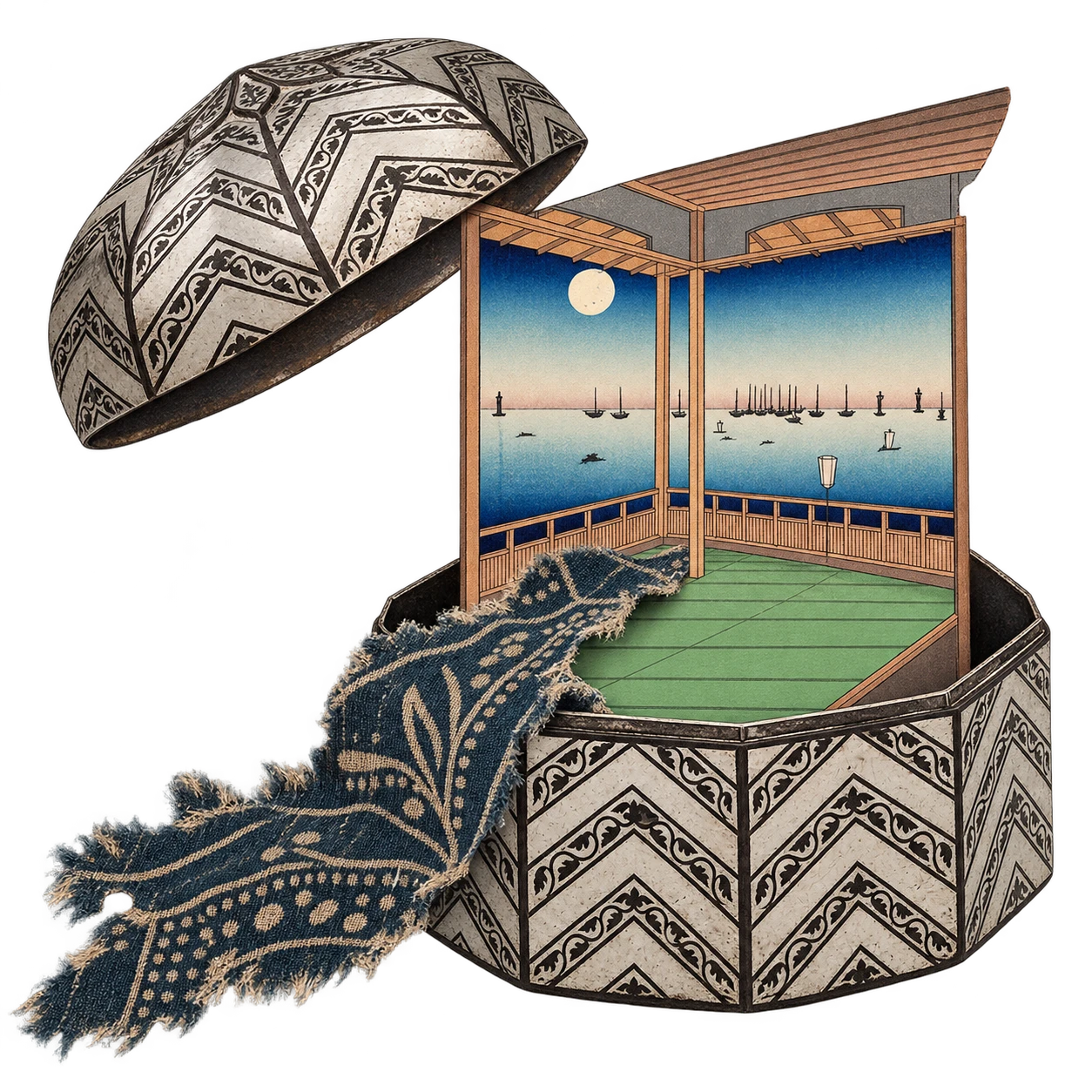
Title in Zodiak 500, as given in the collection.
After, in Newsreader italic: what it was made from, with dates where known. Never “by” an artist who didn’t make it.
Accession in Switzer capitals: AK for the archive, DA for the notebook, then the year and the number.
Sources opens the folio: every museum, artist and licence, with links.
In an album the picture is ruled in with thin coloured lines, the jadval, and floated in a wide margin, the hashiya, scattered with gold.2 Ours: a 1 px lac rule, 3 px of paper, a 1 px gold rule, then paper flecked with gold. On screen it frames the whole window; on a slide it sits inside the bleed; on a card it sits 7 px in.
The flecks never cross into content. The rules never thicken. There is never a second frame inside the first.
Motion
Everything here was once paper, cloth or metal.
It arrives with some weight, settles and keeps still. Nothing bounces to be noticed or loops for attention. Four curves do almost all the moving, and when a visitor has asked their device for less motion, everything fades.
.22, .70, .18, 1 · 700–1,200 ms
Arrivals and reveals: collages, headlines, folios. A quick start and a long, soft landing.
.30, 1.40, .50, 1 · 420–900 ms
The stamp landing, a slip arriving. One small press past the mark, then still.
.65, 0, .35, 1 · 1,200 ms
A page turning, the album opening, a drawer sliding. Weight at both ends.
sine · 4–7 s · ±1.5°
Collages at rest, so slow you feel it more than see it. It stops when nobody is looking.
Every collage has its own choreography, written for what is in it. It arrives once, then breathes. Hover to wake it, tap for its gesture. The buttons play each part on demand.
AK.26.15 · Bring the Unfinished Part · the hand, cloth and moth move as one piece
Each site has three, and each comes from the content. All of them work from a keyboard.
Authentic Kahaniyan’s first screen is a closed album in lac cloth, stamped. The first scroll or tap swings it open onto the first folio. Click it.
The four kinds of research are drawers in a cabinet. Open one and its collage and two lines slide out. Hover or focus them.
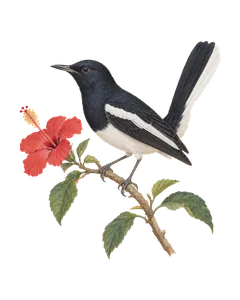
On Dushyant’s site, when a bird calls, a slip slides in with its painting and the minute it was heard. Press listen, with sound on.
Birds and sound
Back to the thrush from Patna.
In the late 1770s Lady Mary Impey kept a menagerie in her garden in Calcutta, and hired three painters from Patna, Shaikh Zain al-Din, Bhawani Das and Ram Das, to paint its birds.12 Paintings like theirs, made by Indian artists for officials of the East India Company, have been called the Company School ever since.
Dushyant’s site has a garden of birds. Sound stays off until a visitor asks for it. Then, by the visitor’s own clock, the garden plays its hour: a quiet bed of Indian field recordings and, now and then, the call of a bird true to that hour. A visitor can add a slow tanpura underneath.13 Each call brings a slip with the bird’s painting, its names and the minute it was heard. The birds are new paintings in the Company School manner, labelled “after the Company School” and never passed off as old.
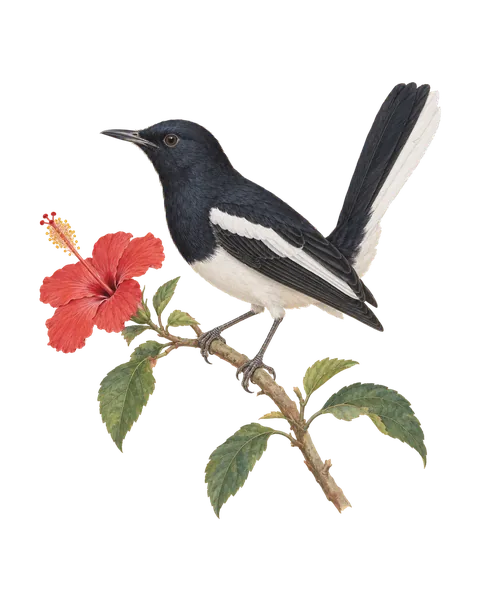
05:00–09:00
Oriental Magpie-Robin, Red-vented Bulbul, Asian Koel, Coppersmith Barbet, over a Western Ghats dawn chorus.
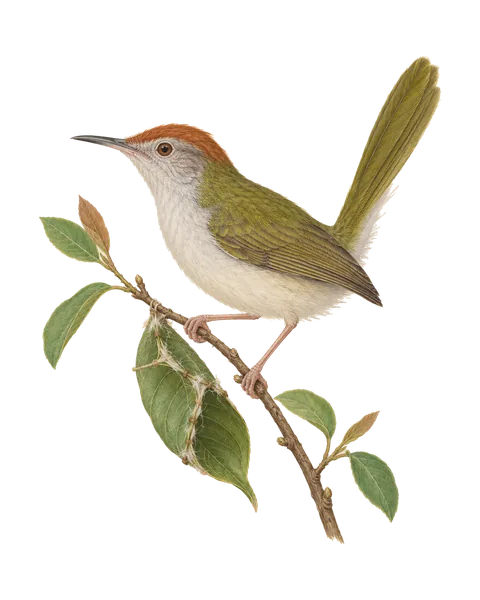
09:00–16:00
Common Tailorbird, Common Iora, Rose-ringed Parakeet, White-throated Kingfisher, Greater Coucal.
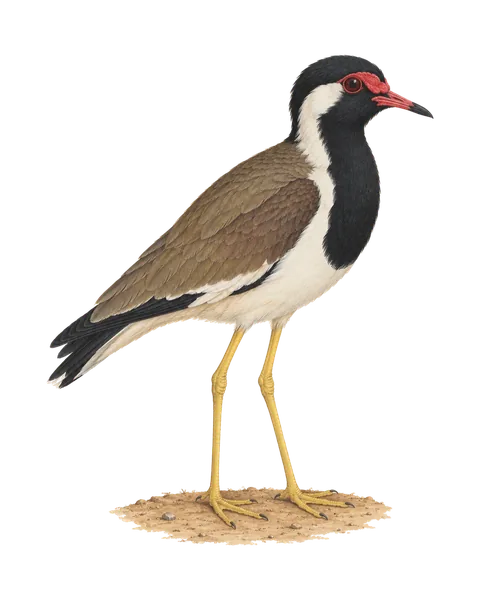
16:00–19:00
Red-wattled Lapwing, Grey-bellied Cuckoo, Jungle Nightjar, Asian Koel. The light warms and the calls thin out.
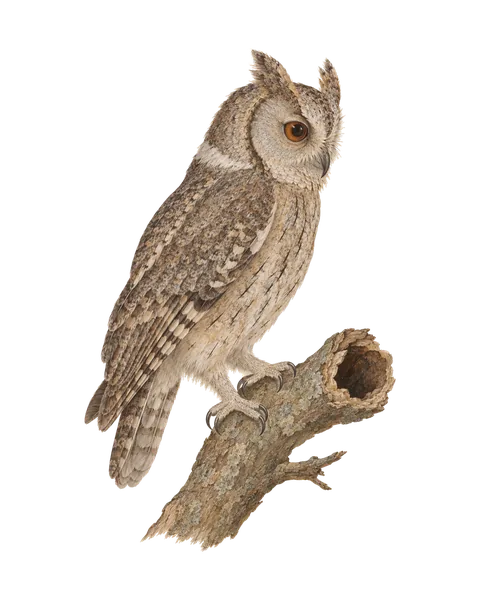
19:00–05:00
Spotted Owlet, Indian Scops-Owl, Indian Nightjar, Brown Fish-Owl. The tanpura moves from Pa to Ma.
Sound starts only when asked. Stop and volume stay in view while it plays.
Calls 30 to 90 seconds apart, never overlapping, placed left or right as if in a garden.
Only birds that call at that time of day, and Mumbai’s own birds first.
Recordist, source and licence on the Field Notes page: 47 of the 66 recordings require it.
The call above: Oriental Magpie-Robin, recorded by renjus box, iNaturalist observation 210797686, CC BY 4.0, level adjusted. The paintings in this chapter are new, made in the Company School manner for this project: 68 birds, 58 of them heard in the garden.
Voice
Both albums speak plainly.
Authentic Kahaniyan says “we”, because it is a practice with collaborators. Dushyant says “I”, and spends the word carefully. Neither tells you how good it is. A signature, a road, a hearing at 3.30 am: the particular thing does that job better than any adjective.
Authentic Kahaniyan · “we”
A signature can open a door, hold someone in a room or pass responsibility to somebody else.
Dushyant Arora · “I”
A lawyer who writes on courts, politics and cinema. I also do research for filmmakers and non-profits.
Do
One collage per section, large, with room around it.
Clients and directors, never ranked by type size. Logos in one colour, unaltered.
Zodiak and Newsreader italics are drawn; never slant a roman.
Lac footnotes for asides and sources, on the sites as in this book.
Don’t
No coffee stains, burnt edges, torn-paper borders or sepia filters. The art is old, and the design doesn’t pretend otherwise.
No deities, scripture or temple motifs as texture.
Names sit still and can be read.
Each album keeps its own mark.
Handle with care
Only what is already public, on his own accounts and in the press, and only as a line of record. Never a headline, a badge or a sell.
Real words and real spellings, checked by a reader of each script. If it can’t be checked, it doesn’t go in.
Collages and bird paintings are new works after historical art, and they say so. No invented provenance, no aged textures suggesting otherwise.
Every client and director as Dushyant supplied them, at the same size, logos in one colour and unaltered. Nothing implied beyond that.
Faces aren’t made comic, stretched or animated for a laugh. Hands are drawn whole. Sacred figures aren’t decoration.
Where everything lives