Authentic Kahaniyan

Sources

The provenance folio.

Every picture on this site is a new collage, made after works in open museum collections. Here is each one, with the works it came from.

Each collage is cut from the works listed under it. Where a piece was widened, blended or redrawn, an image model did it, and its “Used” line says so.

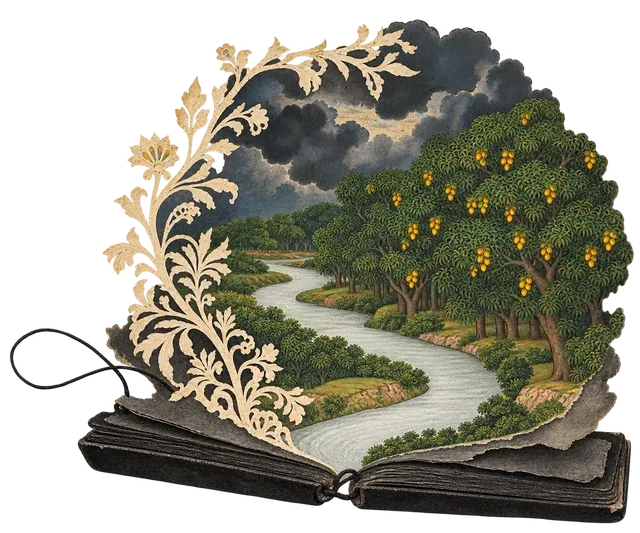
A river winds through a mango grove under storm clouds, rising out of an open palm-leaf manuscript, with a cream cut-paper vine curling up one side.

AK.26.01

A World Between Pages

Collage after a Pali manuscript (1700s), a river at the forest’s edge (1700s) and a cut-⁠paper album page (1625–50).

  1. Pali ManuscriptArtist not identified in catalogue · The Metropolitan Museum of Art · CC0 1.0Used: Cord-bound manuscript, layered dark leaves and looping thread; visible text omitted
  2. Women Enjoying the River at the Forest’s Edge (recto)style of Hunhar II (Indian, active mid-1700s) · The Cleveland Museum of Art · CC0 1.0Used: River, mango grove and storm-cloud fragments only
  3. Album Page with Cut-Paper DecorationArtist not identified in museum catalogue · The Metropolitan Museum of Art · CC0 1.0Used: Cream botanical cut-paper silhouettes; calligraphy omitted
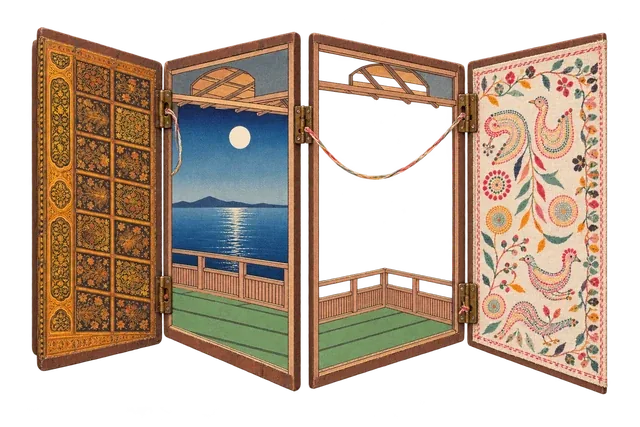
A hinged game board opened like window shutters: inlaid gold panels, a moonlit bay through a timber frame, and a panel of kantha embroidery.

AK.26.02

The Many-Windowed Room

Collage after an inlaid game board (1600s), Hiroshige’s Moon-⁠Viewing Promontory and a Bengal kantha (1800s).

  1. Painted and Inlaid Game BoardUnknown · The Metropolitan Museum of Art · CC0 1.0Used: Golden floral chessboard panels and wooden hinged structure
  2. The Moon-Viewing Promontory, from One Hundred Views of Famous Places in EdoUtagawa Hiroshige (Japanese, 1797–1858) · The Cleveland Museum of Art · CC0 1.0Used: Moonlit bay, green floor and timber window frame; all lettering omitted
  3. KanthaArtist not recorded · The Cleveland Museum of Art · CC0 1.0Used: Off-white stitched fabric surface and tiny coloured embroidered marks
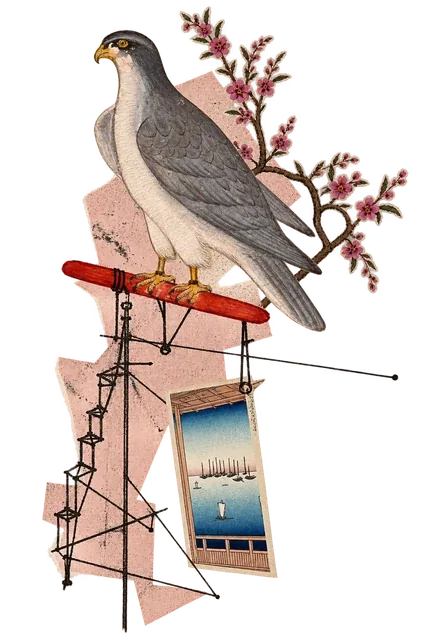
A grey falcon on a red perch, held up by a rigging of fine black lines, with a flowering twig and a small print of the sea.

AK.26.03

Where the Eye Perches

Collage after a Mughal falcon (c. 1610), Paul Klee’s Tightrope Walker and Hiroshige’s Moon-⁠Viewing Promontory.

  1. Falcon on a PerchArtist not recorded · Cleveland Museum of Art · CC0 1.0Used: Grey falcon, red perch and a few flowering twigs
  2. Tightrope WalkerPaul Klee (German, 1879–1940) · The Cleveland Museum of Art · CC0 1.0Used: Fine angular tightrope structure and dusty-pink paper plane; human figure omitted
  3. The Moon-Viewing Promontory, from One Hundred Views of Famous Places in EdoUtagawa Hiroshige (Japanese, 1797–1858) · The Cleveland Museum of Art · CC0 1.0Used: Cool blue sea and a fragment of a printed window frame; lettering omitted
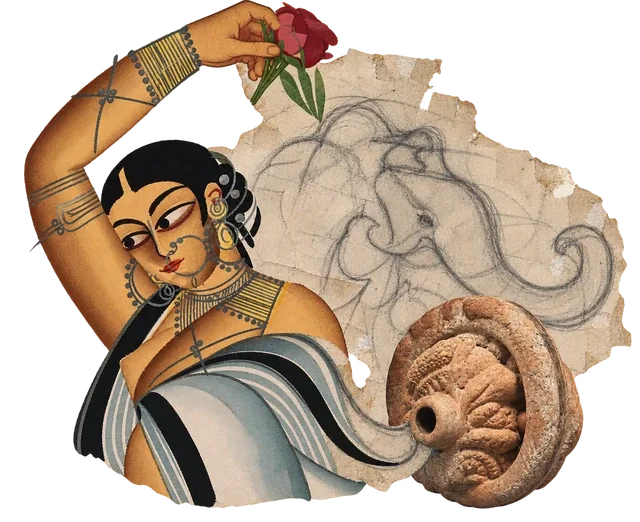
A woman in a striped sari raises a red flower to her hair, in front of pencil sketches of elephants and a worn terracotta wheel.

AK.26.04

Elephants in Pencil

Collage after a gouache of a courtesan at her hair, an elephant practice sheet (1700s) and a Shunga terracotta chariot.

  1. A courtesan arranging a flower in her hair. Gouache painting by an Indian artist, 1800s.Unidentified Indian artist (catalogue attribution) · Wellcome Collection · Public Domain MarkUsed: The bowed head, raised arm and striped garment
  2. Running Elephant (recto); Practice Sheet of Elephant Sketches (verso)Unidentified · The Metropolitan Museum of Art · CC0 1.0Used: Layered pencil sketches of elephants and the irregular paper edge
  3. Model ChariotArtist not recorded · The Cleveland Museum of Art · CC0 1.0Used: Ochre terracotta chariot wheel and worn clay surface
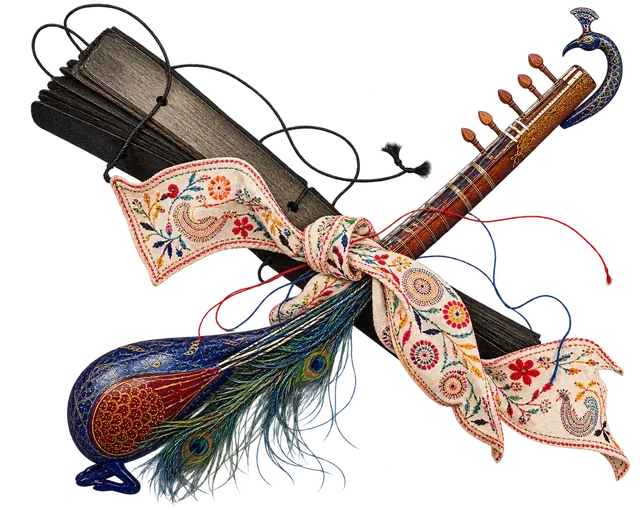
A bound palm-leaf manuscript and a peacock-headed lute cross, tied at the middle with a strip of kantha embroidery.

AK.26.05

Tied with Kantha

Collage after a Pali manuscript (1700s), a taus (1800s) and a Bengal kantha (1800s).

  1. Pali ManuscriptArtist not identified in catalogue · The Metropolitan Museum of Art · CC0 1.0Used: Black layered manuscript leaves and binding cord; writing omitted
  2. Taūs (mayuri)Artist not recorded · The Metropolitan Museum of Art · CC0 1.0Used: Deep-blue peacock lute body, long neck and strings
  3. KanthaArtist not recorded · The Cleveland Museum of Art · CC0 1.0Used: Neutral-white cotton, tiny red and green embroidery and loose thread
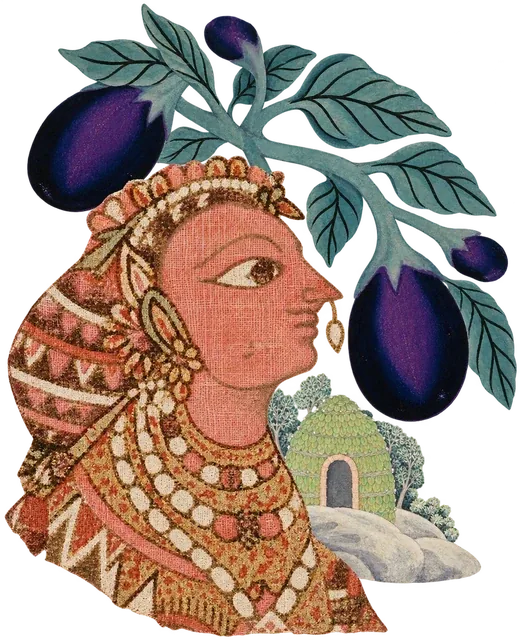
A woman's profile printed on red chintz, under a branch of giant aubergines, with a small leaf-built hut beside her.

AK.26.06

The Place Behind a Face

Collage after a Hikone chintz (1600s), a watercolour of giant aubergines and an Asavari Ragini (c. 1650).

  1. Chintz (Hikone Chintz) with a Woman with a Bird on Her HandUnknown · Tokyo National Museum · CC BY 4.0Used: Large painted cotton profile, eye and patterned neck; bird and original frame omitted
  2. A woman pulling giant aubergines from a tree. Watercolour.Artist not identified in catalogue · Wellcome Collection · Public Domain MarkUsed: Oversized purple aubergines, teal branches and leaves; source figures omitted
  3. Ascetic Princess with Snakes in a Wilderness: Asavari Ragini, from a RagamalaArtist not identified in museum catalogue · The Cleveland Museum of Art · CC0 1.0Used: Small leaf-built hut and pale rocky ground only; ascetic figure and snakes omitted
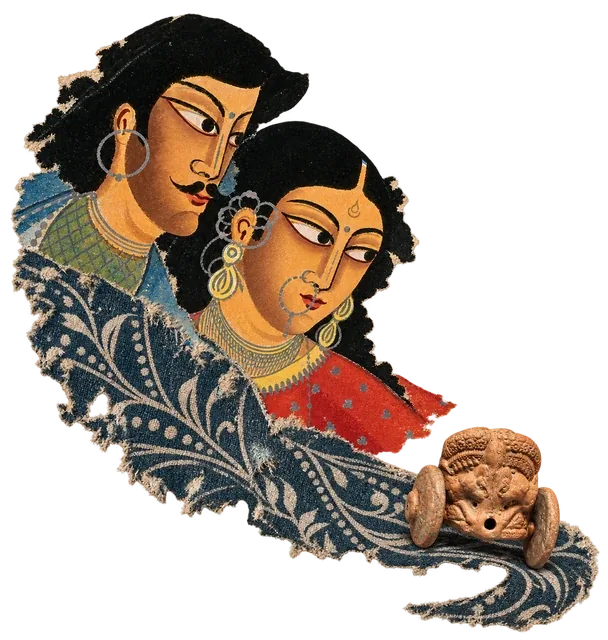
A man and a woman from a Kalighat painting look sideways over a strip of indigo cloth, where a small terracotta chariot rests.

AK.26.07

The World They Knew

Collage after a watercolour of two lovers in an oval, a textile fragment (1100s–1300s) and a Shunga terracotta chariot.

  1. Two lovers surrounded by an oval frame. Watercolour drawing.Artist not identified in catalogue · Wellcome Collection · Public Domain MarkUsed: The two faces and parts of their blue and red clothes; border omitted
  2. FragmentUnknown · The Cleveland Museum of Art · CC0 1.0Used: Frayed indigo cotton and pale resist-dyed curling pattern
  3. Model ChariotArtist not recorded · The Cleveland Museum of Art · CC0 1.0Used: Small worn terracotta chariot with wheels
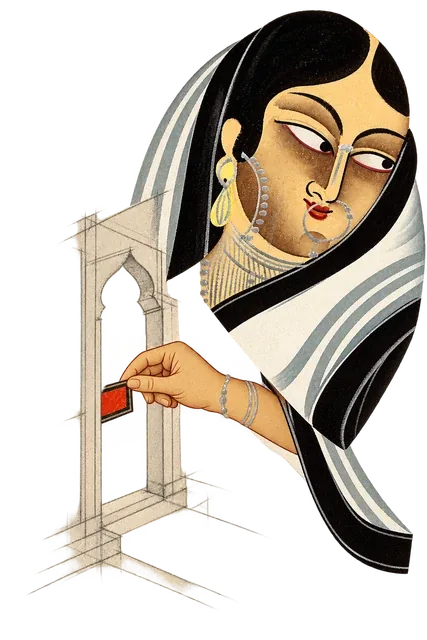
A woman in a black-and-white sari slips a small red document through an unfinished doorway drawn in pencil.

AK.26.08

A Fact Opens a Door

Collage after a watercolour of a woman with a pitcher, Radha’s hair being dressed (c. 1795) and a woman with seven documents (1800s).

  1. A woman holding a pitcher. Watercolour.Artist not identified in catalogue · Wellcome Collection · CC BY 4.0Used: The woman's veiled head, black-and-white drapery and one lowered hand; yellow pitcher omitted
  2. Radha's hair being dressedArtist not identified in museum catalogue · The Cleveland Museum of Art · CC0 1.0Used: Pale unfinished architectural doorway and draft strokes only; sacred figures omitted
  3. A Woman with Seven Documents, Number Seven of the Barat (Document) Suit, Playing Card from a Mughal Ganjifa SetUnknown · Los Angeles County Museum of Art · Public domain — LACMA unrestricted downloadUsed: One vermilion document panel with black edge; all script and seated figure omitted
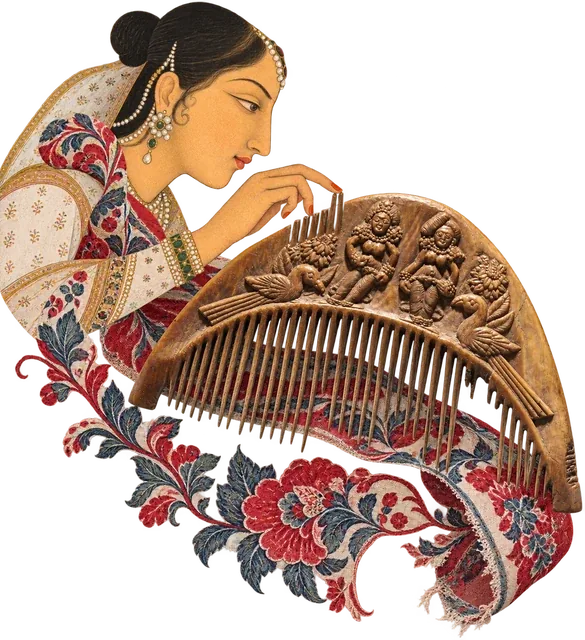
A woman bends over a large carved comb, her shawl turning into red and blue flowering chintz.

AK.26.09

The Comb on the Terrace

Collage after a princess on a terrace at night (c. 1760), a Shunga comb (c. 100 BCE) and a palampore (1700s).

  1. A Princess on a Terrace with Attendants at Night (recto)Artist not identified in museum catalogue · The Cleveland Museum of Art · CC0 1.0Used: Central royal woman's face, raised hand and a small flowing garment fragment; other people and architecture omitted
  2. CombArtist not recorded · The Cleveland Museum of Art · CC0 1.0Used: Arched carved comb with fine teeth and aged ivory surface
  3. PalamporeArtist not recorded · The Metropolitan Museum of Art · CC0 1.0Used: Red-blue flowering chintz branch and fabric edge
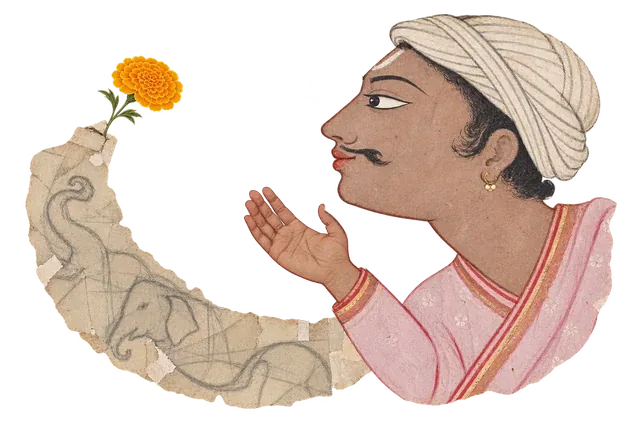
A man in a white turban holds out his hand towards a pale sheet of elephant sketches, from which a single marigold grows.

AK.26.10

Before the Question Has a Shape

Collage after a Tuti-⁠nama garden (c. 1560), an elephant practice sheet (1700s) and a flowering marigold (1700s).

  1. The daughter of the merchant of Mazanderan asks the gardener for the rose, from a Tuti-nama (Tales of a Parrot): Twelfth NightArtist not identified in museum catalogue · The Cleveland Museum of Art · CC0 1.0Used: Far-right pink-robed painted figure's profile and raised hand; text and other figures omitted
  2. Running Elephant (recto); Practice Sheet of Elephant Sketches (verso)Unidentified · The Metropolitan Museum of Art · CC0 1.0Used: Faint overlapping elephant sketches and worn irregular paper
  3. Flowering Marigold (verso)style of Hunhar II (Indian, active mid-1700s) · Cleveland Museum of Art · CC0 1.0Used: One bright marigold flower and thin stem; full border omitted
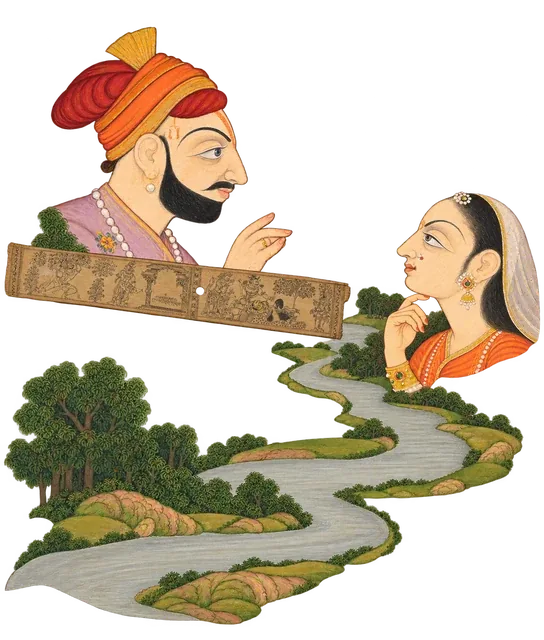
A turbaned man and a veiled woman face each other across a palm leaf and a winding river.

AK.26.11

Across the River

Collage after a Ragamala page (c. 1750), an Odia palm-⁠leaf romance (c. 1740) and a river at the forest’s edge (1700s).

  1. Kausa Ragaputra of Malkos, from a RagamalaArtist not identified in museum catalogue · The Cleveland Museum of Art · CC0 1.0Used: Two opposing painted faces, turban, veil and small gesture fragments; birds and background omitted
  2. Leaf from a Romance of Chandrabhanu and Lavanyavati of Upendra Bhanja (Indian, died 1740)Artist not identified in catalogue · The Cleveland Museum of Art · CC0 1.0Used: Long palm-leaf edge, fastening hole and faint incised scene fragments; all script omitted
  3. Women Enjoying the River at the Forest’s Edge (recto)style of Hunhar II (Indian, active mid-1700s) · The Cleveland Museum of Art · CC0 1.0Used: Small winding pale river and a little dark-green riverbank; people and sky omitted
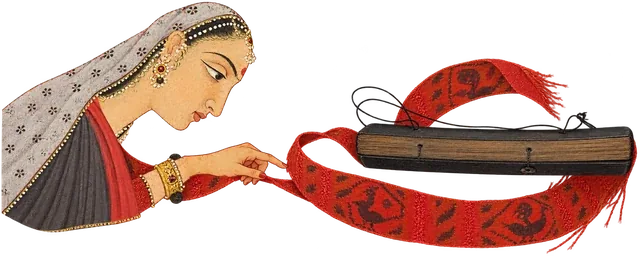
A woman draws a loop of red peacock-patterned cloth around a closed, bound manuscript.

AK.26.12

The Thread Stays With It

Collage after Madhava at his vina (c. 1720), a Pali manuscript (1700s) and a peacock border (1600s).

  1. Madhava plays his vina before five women drawing water from a well, folio 3 from a Madhavanala-KamakandalaArtist not identified in museum catalogue · The Cleveland Museum of Art · CC0 1.0Used: Painted woman at the left edge of the well: face, lowered hand and red-grey garment fragment; scene and other figures omitted
  2. Pali ManuscriptArtist not identified in catalogue · The Metropolitan Museum of Art · CC0 1.0Used: Closed long bound manuscript with black layered leaves and looping thread; writing omitted
  3. Border with Peacock DesignUnknown · The Cleveland Museum of Art · CC0 1.0Used: Narrow vermilion woven border with dark peacock pattern and frayed threads
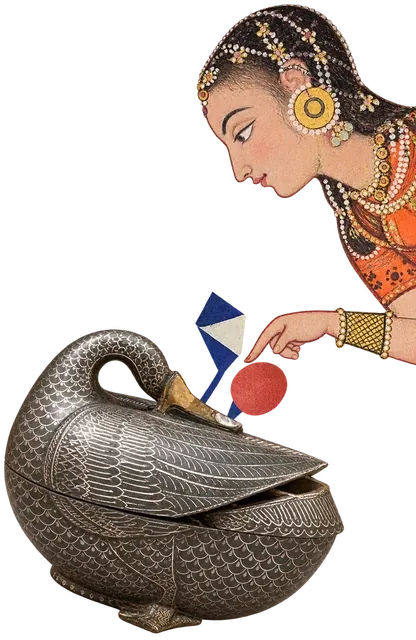
A woman leans down to touch a silver box shaped like a sleeping duck, with a few small coloured shapes between them.

AK.26.14

Another Kind of Knowing

Collage after a Tuti-⁠nama page (c. 1560), a duck-⁠shaped paan box (c. 1700) and Paul Klee’s Carnival in the Snow.

  1. The parrot addresses Khujasta at the beginning of the fifty-second night, from a Tuti-nama (Tales of a Parrot): Fifty-second NightArtist not identified in museum catalogue · The Cleveland Museum of Art · CC0 1.0Used: Painted woman's face and raised hand from the pavilion beside the bird cage; all script, cage and other people omitted
  2. Pan Box in the Shape of a DuckArtist not recorded · The Metropolitan Museum of Art · CC0 1.0Used: Black-silver sleeping-duck pan box, engraved feather patterns and lid seam
  3. Carnival in the SnowPaul Klee (German, 1879–1940) · The Cleveland Museum of Art · CC0 1.0Used: A few plum, coral and blue angular painted shapes; figures omitted
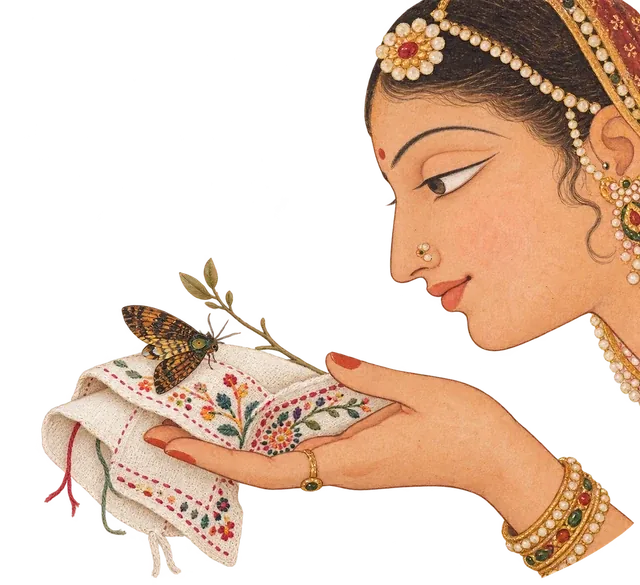
A woman looks down at a moth resting on an embroidered cloth in her open hand.

AK.26.15

Bring the Unfinished Part

Collage after a Todi Ragini (c. 1610), Zain al-⁠Din’s thrush and moth (1778) and a Bengal kantha (1800s).

  1. Woman Feeding Deer: Todi Ragini, from a RagamalaArtist not identified in museum catalogue · The Cleveland Museum of Art · CC0 1.0Used: Woman's painted profile and open feeding hand; deer, landscape and all text omitted
  2. An Orange-Headed Ground Thrush and a Death's-Head Moth on a Purple Ebony Orchid BranchShaikh Zain al–Din · The Metropolitan Museum of Art · CC0 1.0Used: One small moth and a fine twig tip; thrush and full plant omitted
  3. KanthaArtist not recorded · The Cleveland Museum of Art · CC0 1.0Used: Neutral-white embroidered cotton fold with tiny coloured stitches and loose threads
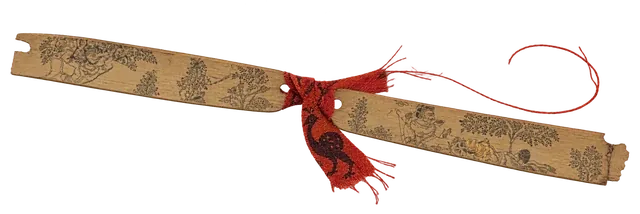
A strip of palm leaf with incised figures, tied with red thread.

AK.26.17

A Thread Kept Open

Collage after an Odia palm-⁠leaf romance (c. 1740) and a peacock border (1600s).

  1. Leaf from a Romance of Chandrabhanu and Lavanyavati of Upendra Bhanja (Indian, died 1740)Artist not identified in catalogue · The Cleveland Museum of Art · CC0 1.0Used: Thin palm-leaf edges, fastening holes and small incised figure fragments; all script omitted
  2. Border with Peacock DesignUnknown · The Cleveland Museum of Art · CC0 1.0Used: Vermilion woven peacock cloth, frayed edge and loose red threads
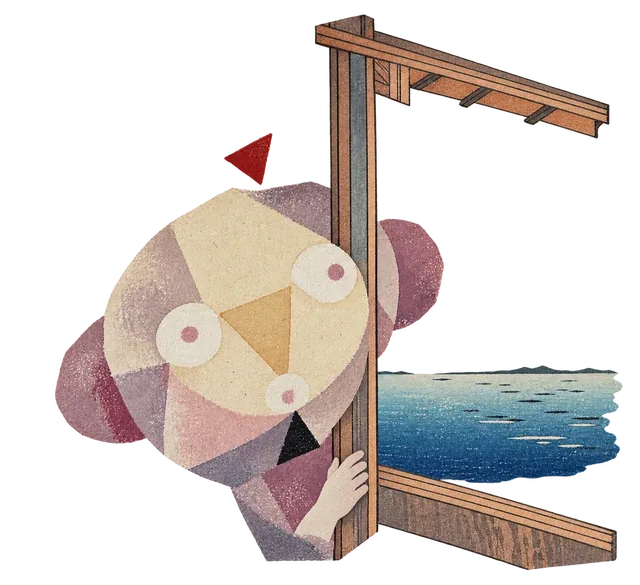
A round, abstract face peers around the corner of a wooden window frame, with a slice of blue sea behind it.

AK.26.18

Another Way In

Collage after Paul Klee’s Carnival in the Snow and Hiroshige’s Moon-⁠Viewing Promontory.

  1. Carnival in the SnowPaul Klee (German, 1879–1940) · The Cleveland Museum of Art · CC0 1.0Used: One round geometric carnival face, its simple eyes and triangular nose; selected blue and red painted shapes
  2. The Moon-Viewing Promontory, from One Hundred Views of Famous Places in EdoUtagawa Hiroshige (Japanese, 1797–1858) · The Cleveland Museum of Art · CC0 1.0Used: One thin wooden window angle and a small slice of blue water; all print inscriptions and room furniture omitted

Portraits

The eight directors were photographed at different events, in different light, so each portrait here is a new picture, made with an image model from the photograph credited below and lit to match the others.

Client names and logos are shown as professional credits, in one colour and unaltered. No endorsement is implied.

Discuss a brief